
How much harvested rainwater can you collect?

A 1 inch of rain on 1,000 square feet produces 600 gallons of water.
Rule of thumb: Plan your system to hold a 2”- 3” rain event.
Rainwater Design
Here’s some helpful tips to make it easier to design your rainwater system. No two systems are exactly alike and there are multiple ways to achieve the same goal!
RAIN HARVESTING SYSTEM DESIGN OVERVIEW
A well-crafted rainwater harvesting system design can help save your home money.
Within a year, many clients could collect 30,000 or more gallons of rainwater. In Texas a 400 gallon tank typically fills 30X annually when collecting from a 500 sq. ft. structure, your garage for example.
Plants love rainwater, it picks up nitrogen as it falls to the earth and doesn’t have any harsh chemicals or salts.
How to plan your rainwater system.
Read on for useful info and answers to frequently asked questions.
Pre-Design Considerations
What are you going to use the water for?
Tank size is often determined by what you use the water for. After all, the best rainwater harvesting system and its storage capacity should meet your household needs with ease.
You may be surprised to learn how much water we use unconsciously. Homeowners here in Texas can use 70% of our water for irrigation on our lawns and gardens alone!
How much can you collect?
In Central Texas, where we get about 32” of rain in a normal year, a one story 2000 sq. foot house can collect 35,000 gallons of rainwater a year. Don’t limit yourself with a rainwater catchment system design that tries to direct that much rain into a 300 gallon tank!
How much space do you have?
Often, space is a limiting factor when it comes to design of a rainwater collection system.
Are there trees that prevent a rainwater harvesting system installation that incorporates large tanks? How high are the eaves on your house? Seven foot tall tanks work well for eight foot eaves. Is there a fence in the way? We’ve temporarily removed fencing to get tanks into place.
Any of these considerations can play a part in determining your usable space for a rainwater harvesting system.
Are you applying for a rebate?
Many municipalities offer rebates from $0.50 / gallon up to $1.00 / gallon when you install a rainwater harvesting system. In some instances, you need to be pre-approved before you purchase and install your tank.
Are you part of an HOA or POA?
Great news! In 2013 the Texas Legislature passed a law prohibiting HOA’s from banning rainwater harvesting systems. They might limit the location of the collected rainwater tank, but they must allow rain barrels and rain-water tanks. If your HOA is unfamiliar with this law, tell them to refer to Texas Property Code Sec 202.007.
Designing Your System
Sizing the Tank
Rule of thumb: plan for a 2” – 3” of water per rain event.
One inch of rain collects 600 gallons per 1000 square feet of covered space (roof). Therefore, if you are collecting from 500 square feet, that will produce 300 gallons on a 1” rain. So, a 500 gallon or larger tank would be appropriate. For larger surface areas, consider using multiple tanks.
Sizing the inlet and overflow
Rule of thumb: match the overflow pipe size to the inlet size. This will ensure the amount of water is able to travel through the system with ease.
If your tank is 1000 gallons or less, you are probably only collecting from one downspout. In that case a 3” inlet is probably fine. If you have 6” gutters you might want to go with a 4” inlet. If you have multiple downspouts, you can still go with 3” PVC piping, but at some point expand to 4” and have a 4” inlet.
Note: If your tank is collecting from one downspout, a basket inlet is often easiest. Simply spin the top so the basket is under the downspout then secure with four screws.
Choose an outlet size
If you are just going to attach a garden hose, go with a 3/4” bulkhead connection. That will allow you to screw a spigot into your rainwater catchment system design.
Pump or no pump?
Many people want to pressurize the water to be able to pump into the house or run an irrigation system. Within city limits pressurized systems need backflow protection devices. Another option is to buy a submersible sump pump.
Keeping debris out of your tank
If your gutters clog with leaves your tank will clog will leaves if you just run it directly into the tank. Gutters screens are your first line of defense.
You may also choose to use a basket on the tank. If those options aren’t doable, a first flush diverter is recommended.
Rainwater Collection Calculator
Installing Your System
Choosing a base
The tank needs to be installed on a solid base supporting the entire bottom. We recommend crushed granite or a similar base. Limestone block, brick, or pavers can also be used.
The simplest thing to do is get some treated landscape timbers and form a square about a foot wider than your tank. Fill with 2”- 3” of crushed granite and tamp down. The tank can sit directly on the crushed granite.
A concrete pad also works! However, keep in mind that water weighs 8.3 pounds per gallon. As such, a 2500 gallon tank weighs over 10 tons when full!
Moving the tank into place
Large tanks slide easily across 2 X 4’s, or better yet, PVC pipes. Tanks can also be tipped on a bottom edge and rolled. Do not lay a large tank on its side and roll it!
Positioning of fittings
Generally, don’t position the overflow above the outlet. If you decide to plumb the overflow, the PVC pipe will come down where your outlet is! The overflow should channel water away from the tank and house towards a low lying area.
Bulkhead connectors
This is an important consideration. These are threaded on both the inside and outside. You will only be able to screw things into the inside of the bulkhead. The outside threads are reversed thread and only accept the locknut.
Therefore, a 3/4” bulkhead accepts a 3/4” spigot, for example.
Painting the PVC
Choose a metallic gray spray paint to make the overflow and inlet look like metal. Rustoleum™ makes a good product available at The Home Depot.
Securing the top
Secure the top of the tank so it doesn’t blow off. Four self-tapping sheet metal screws should be included with your tank. We recommend pre-drilling the holes about 1 1/2” from the edge. The screws go straight down into a lip at the top of the tank.
Design Inspiration
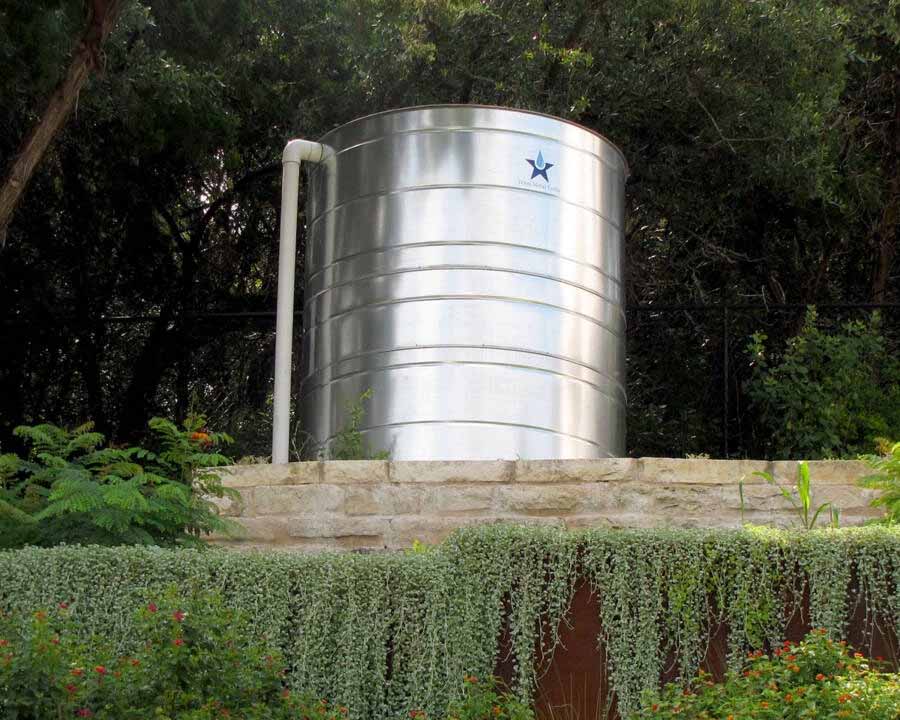
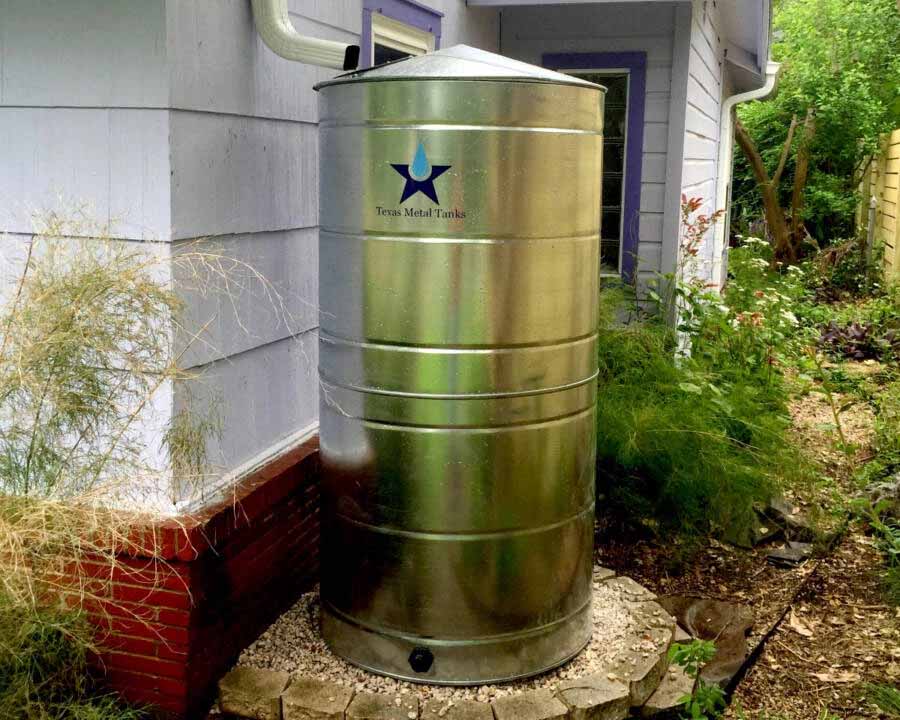
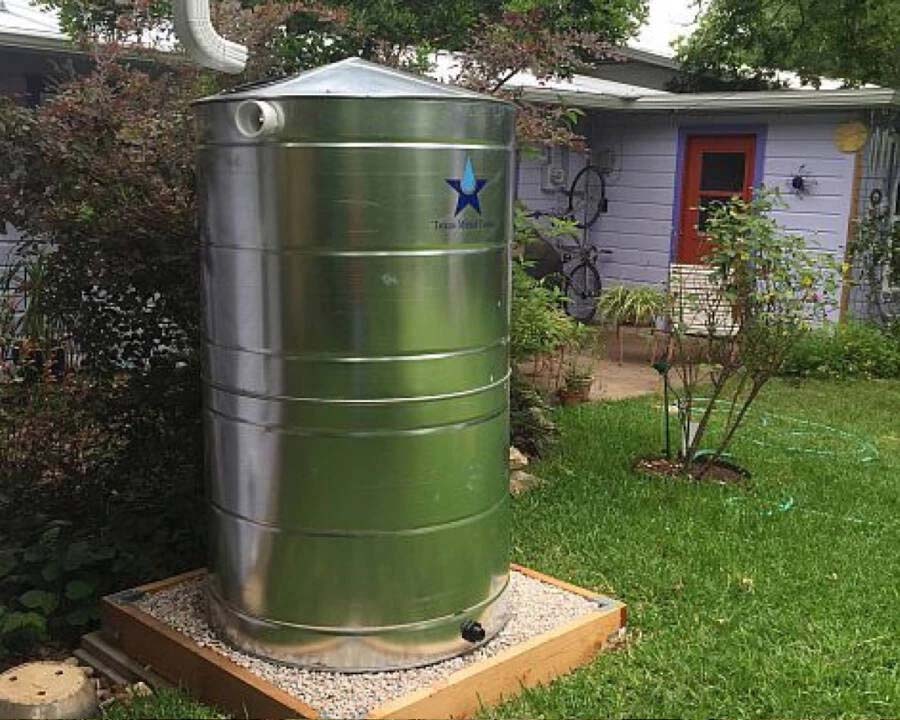
Want to see some of our handywork in-place? See the fruits of our rainwater harvesting system installation in our gallery below:

IMPORTANT DELIVERY INFORMATION
We deliver ourselves or can arrange shipping anywhere in the continental United States as needed. If you are here in Texas, we will likely deliver your rainwater harvesting system design tank ourselves.
If the pad is ready and accessible for delivery, we will help you set the tank on the pad. While tanks don’t weigh a lot, they are bulky and should not be manually lifted. Please ensure there is a clear path, and fence gates are wide enough or fences are temporarily removed.
Tanks up to 1000 gallons will fit laying on their side in a pickup truck. Larger tanks typically come on our trailer standing upright. Tanks are not palletized when we deliver.
Out of state orders will come via a shipping company or a hotshot delivery service. We recommend shipping companies for smaller tanks. We palletize the tank and order a liftgate if possible.
A hotshot delivery is often an independent contractor with a truck and trailer. We recommend this service for large tanks, multiple tanks, or critical time sensitive deliveries. Tanks are not palletized, and we will send you a video showing how to unload.
Contact us for a quote for your shipping needs. Please note out of state shipping can be quite expensive relative to the cost of the tank.
For shipping companies and hotshot deliveries, tanks are fully insured and delivery should not be accepted if damaged.
Tanks can also be picked up at our shop. We recommend 3 – 4 straps per tank.
For deliveries or pickups, the top is separate and gets screwed down once the tank is in place. On large tanks the top will ride behind the tank.
REQUEST A QUOTE
Are you ready to find the best rainwater harvesting system for your home? We are here to guide you. Reach out to our team to request a quote for your project today!